


Motor Testing Solutions for Drones & Unmanned Vehicles
The selection and performance of electric motors directly impact the range, payload capacity, stability, reliability and safety of unmanned vehicles. This knowledge page provides an overview of the most common motor technologies used in UAVs, UGVs, USVs and UUVs, and highlights the key parameters relevant for motor testing and validation.
- Which technical parameters are critical for drone motor testing ?
- How are motors designed for UAV, UGV, USV and UUV applications ?
- What are the most common motor types for unmanned vehicles ?
- Glossary of Technical Terms
- Conlusion
Which technical parameters are critical for drone motor testing ?
Engine testing specifically involves measuring, under controlled and reproducible conditions, the parameters that determine an engine’s actual performance—which often differs significantly from the values advertised by manufacturers.Most often, Magtrol refers to TSP (Torque-Speed-Power) tests, which are the most commonly measured values for a motor.
Electrical Parameters
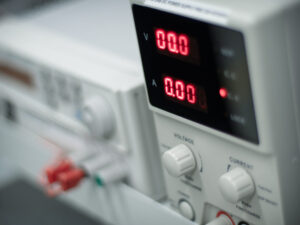 The rated voltage and rated (or continuous) current define the operating range specified by the manufacturer, while the maximum (or peak) current indicates the limit that can be sustained for short periods, particularly during transient phases such as startup or switching operations.
The internal resistance of the winding (Rm), expressed in ohms, generates Joule losses proportional to the square of the current and is a major cause of heating.
The speed constant (KV), expressed in revolutions per minute per volt, indicates the motor’s theoretical no-load speed for each volt applied. The KV value is directly derived from the Ke value, which is measured in no-load generator mode. A high KV value corresponds to a high-speed motor with low torque, suitable for small-diameter propellers, while a low KV value favors torque, suitable for large propellers with high pitch.
The torque constant (Kt) and back-EMF constant (Ke) relate torque to current and the induced voltage to rotational speed, respectively.
The no-load current (I0) measures the motor’s power consumption without a payload, reflecting internal friction and magnetic losses.
Finally, the overall electromechanical efficiency—the ratio of useful mechanical power to electrical power consumed—summarizes the motor’s energy efficiency and directly determines the drone’s flight time.
Mechanical Parameters
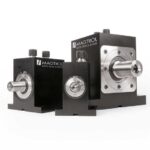 Torque (N·m), measured at rest (static torque) or during operation (dynamic torque), characterizes the motor’s ability to drive a given load. The actual rotational speed under load (rpm) deviates from the theoretical speed calculated from the KV value due to losses and the load applied by the propeller. Thrust, a key parameter for a drone motor, is measured either statically on a fixed test stand; the thrust-to-weight ratio of the powertrain is a key indicator of an aircraft’s maneuverability and safety margin.
Rotor inertia influences the motor’s responsiveness to control inputs, a particularly sensitive parameter on competition drones.
Cogging torque is a slight resistance felt at very low speeds due to the magnetic attraction between the magnets and the stator laminations; it affects the smoothness of rotation at low rpm. Magtorl offers a turnkey Cogging Test System specifically designed for this purpose.
Finally, vibration and noise levels are increasingly being tested because they impact the drone’s structural fatigue, the quality of onboard sensors, and the social acceptability of flight, particularly for urban eVTOLs.
Thermal Parameters
The temperature of the winding and the stator under steady-state conditions is a major limiting factor: above a certain threshold, performance degrades and the motor’s service life decreases significantly, and there is even a risk of failure.
Thermal drift in performance (decrease in available torque, changes in the magnetic behavior of the magnets) must be characterized over time. Thermal management most often relies on passive cooling via the airflow generated by the propeller and the design of the housing.
How are motors designed for UAV, UGV, USV and UUV applications ?
Outrunner
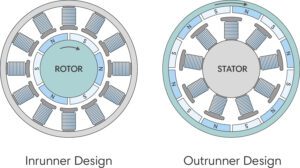
The most common architecture and configuration used in drones: a rotating outer ring houses the magnets and directly drives the propeller. This architecture provides high torque at low speeds without requiring a gearbox.
Inrunner
The opposite design and configuration, where the internal rotor spins inside a stationary stator. The motor spins faster but produces less torque, and often requires a gearbox to drive the propeller.
Coreless Motors
Coreless motors are commonly found in nano- and micro-drones; the rotor windings of these motors do not contain a ferromagnetic core. The absence of this core significantly reduces the rotor’s inertia, allowing for very rapid acceleration and deceleration, though at the cost of more limited torque and power. This design is also used in certain small onboard servomotors.
Frameless Motors
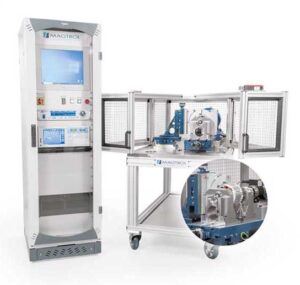
Complete Test Bench for Frameless Motors
These motors are supplied as a kit consisting solely of the stator and rotor, without a housing, shaft, or bearings. This leaves the mechanical integration entirely up to the designer. This allows the motor to be integrated directly into the structure it drives, reducing overall weight and footprint compared to a conventional motor.
This approach is common in camera gimbals, robotic joints and increasingly in custom-built heavy-lift drone platforms, where tight integration with the airframe and cooling system takes precedence over the convenience of a standard product. The trade-off lies in increased technical complexity, as the bearings, alignment, and thermal management—which are typically integrated into the motor—must be designed and validated separately.
Magtrol successfully manufactures test benches for frameless motors,
Internal Combustion, Hybrid, and Jet Engines
For drones requiring long flight times or a heavy payload, electric motors alone quickly reach their limits due to the energy density of batteries. Internal combustion engines (2- or 4-stroke) and hybrid systems (in which a thermal generator recharges a buffer battery) offer significantly longer flight times. Miniature turbojet or turboprop engines, which are less common, are primarily used in target drones and certain high-speed military drones.
Magtrol offers solutions for internal combustion engine testing (ED Series Dynamometers) specifically designed to withstand loads and vibrations.
What are the most common motor types for unmanned vehicles ?
BDC (Brushed DC Motor).
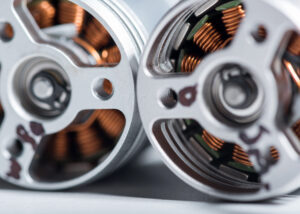
Brushed DC motors use mechanical commutation, where current is transferred to the rotor via brushes and a commutator. They offer a simple and low-cost design and were widely used in early drones and small consumer UAVs. However, their limited efficiency, mechanical wear and maintenance requirements have led to their replacement in most modern unmanned vehicle applications.
BLDC (Brushless DC Motor)
BLDC motors are the current industry standard for drones and unmanned vehicles. Unlike brushed motors, commutation is handled electronically by an Electronic Speed Controller (ESC), which sequentially energizes the stator windings to generate a rotating magnetic field. The rotor, equipped with permanent magnets, follows this field without mechanical contact, resulting in higher efficiency, improved reliability and virtually maintenance-free operation (excluding bearings).
PMSM (Permanent Magnet Synchronous Motor)
PMSM motors are closely related to BLDC motors but are typically controlled using Field-Oriented Control (FOC). This enables continuous current control in each phase, resulting in higher efficiency, smoother torque delivery, reduced cogging effects and lower acoustic noise. However, PMSM systems require more advanced control electronics and often higher-resolution rotor position feedback. They are commonly used in applications where efficiency, smooth operation and low noise are critical, such as eVTOL aircraft and advanced UAV platforms operating in noise-sensitive environments..
Glossary of Technical Terms
- BLDC (Brushless DC) : A brushless DC motor whose commutation is electronically controlled by an ESC.
- Back-EMF (back ElectroMotive Force) : Voltage induced by the motor’s rotation, used in particular by some ESCs to estimate the rotor’s position without a dedicated sensor.
- BVLOS (Beyond Visual Line of Sight): Refers to drone operations conducted outside the pilot’s direct line of sight, which imposes stricter requirements for reliability, detection, and redundancy compared to line-of-sight flight.
- C-Rating : An indicator of a battery’s ability to deliver a current proportional to its rated capacity; influences the maximum current available to the motor.
- Cogging Torque : A jerking sensation felt at very low speeds, caused by the magnetic attraction between the rotor magnets and the stator laminations. (read more: CTS 100 Series)
- DAQ (Data Acquisition System) : A unit that synchronizes and records all test bench signals at a high sampling rate (read more: DSP 7010)
- Disk Loading : Ratio between the weight carried and the area swept by the propeller; influences the overall aerodynamic efficiency of the propulsion system.
- DShot : Digital control protocol for ESCs, more precise and less susceptible to noise than conventional analog PWM.
- Efficiency Curve : Shows the motor’s electromechanical efficiency across its entire operating range, typically in the form of a torque-speed map.
- ESC (Electronic Speed Controller) : Electronic controller that manages the commutation and speed of a brushless motor.
- eVTOL (electric Vertical Take-Off and Landing) : Is an electrically powered aircraft capable of taking off and landing vertically, combining the thrust limitations of a multirotor during takeoff with the efficiency of a fixed wing during cruise.
- FOC (Field Oriented Control) : A sinusoidal motor control strategy that is more precise and quieter than conventional trapezoidal control.
- I0 (no-load current) : The current consumed by the motor without a payload, reflecting internal losses due to friction and magnetism.
- Kt / Ke : Motor torque and back-EMF constants, numerically linked in consistent SI units and consistent reference frame.
- KV : Motor speed constant, expressed in revolutions per minute per volt applied at no load.
- Load Cell : A force sensor that converts a mechanical force (torque or thrust) into an electrical signal that can be processed by the data acquisition system.
- MTBF (Mean Time Between Failures) : Average time between two failures; a reliability indicator used particularly for BVLOS applications.
- Outrunner / Inrunner : Two brushless motor configurations: rotating outer shell (outrunner, high torque) or internal rotor (inrunner, high speed).
- Power Analyzer : An instrument that simultaneously measures voltage, current, and instantaneous power with sufficient accuracy to calculate a reliable efficiency. (read more: Model 7500)
- Power Curve : Shows the mechanical power output (or electrical power consumption) as a function of rotational speed or current, and highlights the point of maximum efficiency.
- PWM (Pulse Width Modulation) : A standard method of analog control for motors and servos.
- Rm (winding resistance) : The motor’s internal electrical resistance, the primary source of Joule losses.
- Reference propeller : A calibrated and standardized propeller used to compare multiple engines under strictly identical load conditions.
- Swarm : Refers to a group of coordinated drones that move and act collectively according to a shared logic, rather than each drone being controlled individually.
- Test Cycle : A programmed sequence of load steps or flight profiles reproduced on a test bench to characterize the engine under conditions representative of the intended mission.
- Thermal Drift : The change in engine performance (torque, resistance, efficiency) as a function of its temperature rise during steady-state operation.
- Thrust-to-weight ratio : The ratio of maximum available thrust to the aircraft’s total weight, a key indicator of maneuverability.
- Torque-speed curve : Shows how available torque varies with rotational speed and helps identify the motor’s optimal operating point for a given load. (read more: M-TEST 7 software)
Conclusion
The combination of architectures, performance parameters, and application constraints explains why engine testing plays a central role in the development and qualification of drones and UAVs. Accurately measuring an engine’s torque, thrust, efficiency, or thermal behavior under reproducible conditions that are representative of the intended mission makes it possible to validate design choices well before the first flight and to anticipate the risk of degradation over time.
Ready for your solution? Contact us today.


